
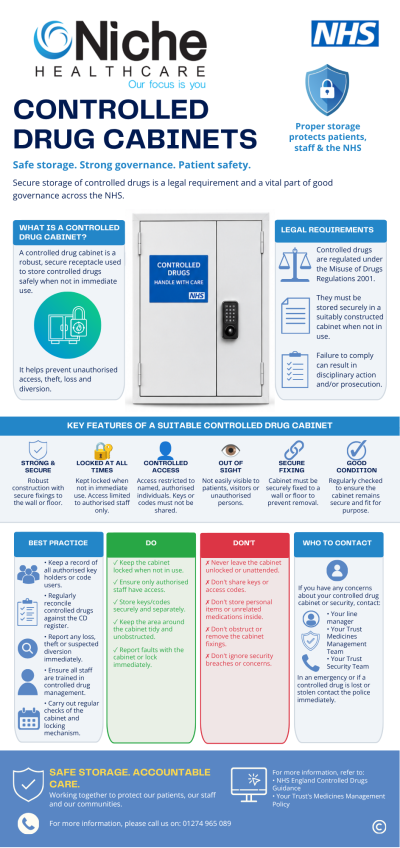
Across the NHS, the secure storage of controlled medicines is a critical responsibility that directly impacts patient safety, legal compliance, and organisational governance. Controlled Drugs Cabinets play a vital role in protecting medicines from unauthorised access while ensuring healthcare professionals can access them quickly when required for patient care. Whether in hospitals, GP surgeries, community health centres, mental health facilities or hospices, selecting the right cabinet is an essential part of maintaining safe medicines management.
At Niche Healthcare, we understand the unique challenges NHS organisations face when sourcing compliant healthcare storage solutions. From supporting medicines management teams to helping estates departments specify secure equipment, we provide high-quality healthcare furniture and storage designed to meet the demands of modern clinical environments.
Why Controlled Drugs Cabinets Are Essential in the NHS
Controlled drugs are subject to strict legal controls because of their potential for misuse, abuse or diversion. Medicines such as morphine, fentanyl, oxycodone and certain benzodiazepines require enhanced security throughout their storage, handling and administration.
A properly specified controlled drugs cabinet provides significantly more than physical storage. It forms part of a wider medicines governance strategy that helps NHS organisations demonstrate compliance, improve accountability and reduce clinical risk.
Healthcare providers must balance robust security with efficient clinical workflows. Staff need rapid authorised access during patient treatment, while ensuring medicines remain protected at all other times. A high-quality cabinet provides this balance by combining secure construction with reliable locking systems and practical internal storage.
Understanding the Requirements for Controlled Drugs Cabinets
The storage of controlled drugs in England is governed by legislation alongside professional guidance and NHS policies. Cabinets should be designed specifically for controlled medicines rather than adapted from general-purpose storage.
The Misuse of Drugs (Safe Custody) Regulations establish requirements for secure storage, while healthcare organisations should also follow relevant NHS policies and local medicines management procedures. Guidance from the Care Quality Commission, NHS organisations and the Health and Safety Executive all contribute towards best practice in medicines security and workplace safety.
Selecting an appropriate cabinet involves considering factors including cabinet size, construction, locking mechanisms, fixing arrangements and the environment in which it will be installed.
Choosing the Right Controlled Drugs Cabinets for Different Healthcare Settings
Every NHS environment has different operational requirements, making it important to select cabinets that reflect the needs of individual departments.
An acute hospital pharmacy may require large-capacity cabinets capable of storing significant quantities of controlled medicines across multiple shelves. By contrast, a GP surgery or community clinic may only require a compact cabinet suitable for holding smaller stock levels while maintaining full security.
Mental health services, ambulance stations, hospices and prison healthcare facilities each have their own medicines management procedures, meaning storage solutions should always align with local risk assessments and operational policies.
Future growth should also be considered. Selecting a cabinet with sufficient capacity allows organisations to accommodate changes in service demand without needing early replacement.
Security Features That Matter
Not all secure cabinets are suitable for controlled drugs. NHS procurement teams should look for cabinets specifically manufactured for healthcare applications and designed to withstand attempted unauthorised access.
Robust steel construction is essential, helping resist forced entry while providing long-term durability in busy clinical environments. High-quality hinges, reinforced doors and secure fixing points all contribute towards overall security.
Reliable locking mechanisms are equally important. Cabinets should support local key management procedures and enable authorised access while reducing opportunities for unauthorised entry.
Internal shelving should allow medicines to be organised clearly, reducing the risk of dispensing errors and making stock checks more efficient. Good visibility also supports routine controlled drug audits carried out by pharmacy teams.
Supporting Medicines Governance and Compliance
Controlled drugs require meticulous record keeping. Secure storage forms only one part of wider medicines governance, which also includes stock reconciliation, administration records, incident reporting and regular auditing.
A suitable cabinet supports these processes by keeping medicines organised and accessible for authorised personnel. Pharmacy staff can complete routine stock checks more efficiently, while clinicians benefit from clear storage arrangements that reduce delays during patient care.
When combined with robust local procedures, secure cabinets contribute towards reducing discrepancies and strengthening overall governance.
Healthcare organisations are increasingly focused on demonstrating compliance during inspections and audits. Investing in compliant storage helps provide confidence that medicines security is being taken seriously across the organisation.
Installation Is Just as Important as the Cabinet
Even the highest quality controlled drugs cabinet can fail to provide adequate security if installed incorrectly.
Cabinets should be securely fixed to suitable building structures using appropriate fixings. Installation should consider wall construction, accessibility for authorised staff and the overall security of the room in which the cabinet is located.
Many NHS organisations incorporate cabinet installation into wider estates and refurbishment projects to ensure compliance from the outset. Positioning should support clinical workflows while avoiding unnecessary visibility to patients or visitors.
Routine inspections should also verify that fixings remain secure and locking mechanisms continue to operate correctly throughout the cabinet’s service life.
The Benefits of Investing in Quality Controlled Drugs Cabinets
Purchasing a high-quality cabinet represents an investment in patient safety as much as physical security.
Well-manufactured cabinets typically provide many years of reliable service with minimal maintenance. Durable finishes withstand frequent cleaning, helping maintain hygiene standards within clinical environments.
Improved organisation also contributes towards operational efficiency. Pharmacy teams spend less time managing storage issues, while clinicians benefit from clear access arrangements during medicines administration.
Most importantly, secure storage helps reduce the likelihood of theft, diversion or unauthorised access, supporting both patients and healthcare professionals.
Supporting Infection Prevention and Healthcare Hygiene
Although the primary purpose of controlled drugs cabinets is security, hygiene remains an important consideration within healthcare environments.
Cabinets should be easy to clean using approved cleaning products without damaging painted finishes or locking mechanisms. Smooth surfaces and durable coatings help support infection prevention protocols across wards, clinics and treatment rooms.
By integrating secure medicines storage into wider infection prevention strategies, NHS organisations can create environments that support both patient safety and operational efficiency.
Why NHS Organisations Choose Niche Healthcare
At Niche Healthcare, we specialise in supplying practical healthcare solutions designed specifically for NHS organisations and healthcare providers throughout the UK.
We understand that procurement decisions involve far more than purchasing equipment. Buyers need confidence that products are suitable for demanding clinical environments, offer long-term value and support compliance with healthcare standards.
Alongside controlled drugs storage, we supply a comprehensive range of healthcare furniture, medical storage and workplace solutions designed to improve clinical environments and support frontline staff.
To learn more about the Controlled Drugs Cabinets, visit:
Controlled Drugs Cabinets – Niche Healthcare
Our complete healthcare range is available at:
Healthcare Supplies UK | NHS Medical Supplier | Niche Healthcare
Best Practice for Ongoing Cabinet Management
Purchasing compliant Controlled Drugs Cabinets is only the beginning. Long-term effectiveness depends on consistent operational procedures and regular monitoring.
Healthcare organisations should ensure cabinet access is limited to authorised personnel and supported by robust key management procedures. Regular inspections should confirm locks, hinges and fixings remain in good condition, while pharmacy teams should continue routine stock reconciliation in accordance with local medicines policies.
Staff training also plays an important role. Everyone handling controlled medicines should understand both local procedures and the importance of secure storage as part of safe medicines management.
Regular review of storage capacity is equally valuable. As services evolve, cabinet capacity may need to increase to support changing patient activity or service expansion.
Frequently Asked Questions
What are Controlled Drugs Cabinets used for? Controlled Drugs Cabinets are purpose-built secure storage units used to store medicines that are subject to additional legal controls. Within NHS settings they help protect controlled medicines from theft, misuse and unauthorised access while supporting medicines governance and patient safety.
Do all NHS departments require the same type of cabinet? No. The most suitable cabinet depends on the quantity of medicines stored, the clinical setting and local risk assessments. Hospitals, GP practices, hospices and community services often require different cabinet sizes and storage capacities.
How often should Controlled Drugs Cabinets be inspected? Cabinets should be checked regularly as part of routine medicines management procedures. Inspections should include locks, hinges, fixings and the overall condition of the cabinet, alongside ongoing controlled drug stock reconciliation.
Where can NHS organisations find official guidance? NHS organisations should refer to national guidance alongside local medicines policies. Useful resources include the NHS website at NHS website for England – NHS, the Health and Safety Executive at HSE: Information about health and safety at work and relevant legislation concerning the safe custody of controlled drugs.
Conclusion
Effective medicines management begins with secure storage, making Controlled Drugs Cabinets an essential investment for every NHS organisation handling controlled medicines. By selecting robust, purpose-built cabinets and combining them with strong governance procedures, healthcare providers can improve security, support regulatory compliance and protect both patients and staff.
At Niche Healthcare, we are committed to supplying dependable healthcare storage solutions that meet the practical needs of NHS organisations across the UK. Whether you are refurbishing a pharmacy, upgrading a ward or equipping a new healthcare facility, our range of healthcare products is designed to support safer, more efficient clinical environments.
HEC Showman HECDC100 Controlled Drugs Cabinet

Controlled Drugs Cabinets
See our full selection:
Healthcare Supplies in Aberdeen | Niche Healthcare
Healthcare Supplies in Basildon | Niche Healthcare
Healthcare Supplies in Basingstoke | Niche Healthcare
Healthcare Supplies in London | Niche Healthcare
For procurement details, bulk purchasing, and further product information, contact our team today on 01274 965089 or check out our website at www.nicheofficesolutions.co.uk / www.nicheofficesolutions.co.uk/niche-nhs
Further clinical information can be found on our blog page: www.nicheofficesolutions.co.uk/category/niche-healthcare-news
For products not found on our online website, please view our Healthcare catalogues: www.nicheofficesolutions.co.uk/healthcare-catalogues
View our Healthcare YouTube videos Playlist
If you have any additional questions, drop us an email at info@nicheofficesolutions.co.uk