
Could a Midwife Be Monitoring the Wrong Baby’s Heartbeat Without Realising?
An MHRA safety warning has revealed a concerning risk involving certain wireless fetal monitoring systems. Could a baby’s heartbeat appear on another patient’s monitor without clinical staff immediately recognising the problem?
Imagine a midwife monitoring a baby’s heartbeat during labour. The cardiotocography (CTG) monitor is displaying a fetal heart rate, and the clinical team is using the recording to help assess the baby’s wellbeing.
Everything appears to be functioning normally.
But what if the heartbeat displayed on the screen actually belongs to a different baby in another maternity room?
It sounds like something that should not be possible in a modern hospital. However, on 17 September 2026, the Medicines and Healthcare products Regulatory Agency (MHRA) published an important safety warning identifying precisely this potential problem.
The warning highlights wireless CTG monitoring risks, including signal crossover, inaccurate fetal heart rate recordings and wireless communication interruptions.
In rare circumstances, a fetal heart rate signal from one monitoring system may appear on another monitor operating on the same radiofrequency channel.
The findings raise important questions about maternity patient safety, equipment reliability and how healthcare professionals can ensure they are monitoring the correct baby.
For NHS Trusts, maternity departments, obstetric teams, clinical engineers and healthcare procurement professionals, the warning is an important reminder that medical equipment safety extends beyond whether a device appears to be working correctly.
The MHRA Warning That Could Change How Maternity Teams Assess Wireless Monitoring
On 17 September 2026, the MHRA issued Device Safety Information DSI/2026/012, titled Radiofrequency (RF) Safety Considerations for Wireless Cardiotocography (CTG) Monitoring Systems.
The communication followed a review of wireless fetal monitoring equipment using radiofrequency telemetry channels.
The MHRA identified several potential safety issues involving certain wireless CTG systems, particularly classic telemetry devices operating within the Industrial, Scientific and Medical (ISM) frequency band.
One of the most concerning findings involved signal crossover between monitoring systems.
This can occur when two wireless CTG devices operate on the same radiofrequency channel without sufficient separation, potentially allowing the fetal heart rate signal from one device to appear on another monitor.
The MHRA also identified risks involving incorrect or inconsistent readings, signal persistence after transducers have been removed and signal dropout.
These issues could result in clinicians misinterpreting CTG recordings and making inappropriate clinical decisions.
Importantly, the MHRA has not stated that all wireless fetal monitoring systems are unsafe.
The warning concerns specific radiofrequency risks associated with certain telemetry technologies and operating conditions.
Nevertheless, the findings demonstrate why clinical verification, correct equipment configuration and appropriate maintenance are essential components of maternity patient safety.
Could a Baby’s Heartbeat Really Appear on a Monitor in Another Room?
Yes. The MHRA has confirmed that signal crossover can occur in rare circumstances involving certain wireless CTG systems.
Cardiotocography is used to monitor fetal heart rate patterns and uterine contractions during pregnancy and labour.
Traditional CTG equipment uses wired transducers connected to a monitoring unit.
Wireless CTG systems transmit monitoring information using radiofrequency communication, allowing women greater freedom of movement during labour.
This can be beneficial when continuous fetal monitoring is clinically indicated.
However, some wireless systems operate using a limited number of available radiofrequency channels.
If multiple devices operate within range on the same channel, interference or signal crossover may occur.
Hospital Walls May Not Prevent Signal Interference
One particularly surprising detail in the MHRA warning is that physical separation between maternity rooms does not necessarily eliminate the risk.
Radiofrequency signals can travel between adjacent rooms and even between different floors.
The MHRA explains that, for certain devices operating on the same channel, a separation distance of approximately 100 metres may be required in the absence of obstacles to prevent signal crossover.
This is an illustrative example rather than a universal requirement. Healthcare organisations must consult the relevant manufacturer’s instructions for device-specific guidance.
For maternity departments operating several wireless CTG systems simultaneously, the warning highlights the importance of understanding how equipment communicates within the hospital environment.
Why Is Signal Crossover Particularly Concerning?
The problem is not simply that a monitor might stop displaying information.
In a signal crossover event, a monitor could potentially continue displaying a fetal heart rate that originates from another patient.
This creates a different challenge from an obvious equipment failure.
When a monitor loses its signal completely, clinical staff may immediately recognise that monitoring information is unavailable.
However, when a device continues displaying a plausible fetal heart rate, identifying an incorrect signal may be more difficult.
This is why the MHRA emphasises the importance of verifying that the displayed fetal heart rate belongs to the correct patient and corresponds with the wider clinical assessment.
Three Wireless CTG Monitoring Risks Identified by the MHRA
The September 2026 safety communication highlights several technical concerns that healthcare organisations should understand.
Signal crossover occurs when a wireless monitoring system receives information originating from another device.
In maternity care, this could result in one baby’s fetal heart rate appearing on a monitor associated with another patient.
The risk is associated with devices operating on the same radiofrequency channel without adequate separation or other appropriate controls.
The MHRA also identified risks involving incorrect or inconsistent CTG traces.
Interference or other technical factors may affect the reliability of the information displayed.
The safety communication also describes signal persistence, where recording may continue after monitoring transducers have been removed.
Because CTG recordings contribute to clinical decisions during labour, inaccurate information could affect how a baby’s condition is interpreted.
Signal dropout occurs when communication between wireless monitoring components is interrupted.
This may result in temporary loss of fetal monitoring information.
NICE guideline NG229, Fetal Monitoring in Labour, recommends switching to wired transducers as soon as possible if signal loss cannot be resolved by reducing the distance between the base unit and the woman.
The recommendation reinforces the importance of having suitable alternative monitoring equipment available.
Why a Normal Heartbeat Does Not Always Tell the Full Story
Fetal heart rate monitoring is an important component of maternity care.
Clinicians use CTG recordings alongside maternal observations, uterine activity, labour progression and other clinical findings to assess fetal wellbeing.
However, an apparently reassuring heart rate is only useful when the recording accurately represents the baby being monitored.
NICE guidance emphasises that CTG interpretation should be considered alongside the complete clinical picture rather than used as an isolated assessment.
This becomes especially important when there are concerns about signal quality, equipment performance or the identity of the fetal heart rate being recorded.
A recording that appears normal cannot reliably indicate a baby’s condition if the signal belongs to another patient.
Similarly, an inaccurate recording could potentially lead to unnecessary concern or inappropriate clinical intervention.
The MHRA warning therefore reinforces a fundamental principle of patient safety: clinical information must be both accurate and correctly associated with the patient.
Could a CTG Monitor Accidentally Record the Mother’s Heartbeat Instead?
Yes, although this is a separate issue from wireless signal crossover.
Maternal and fetal heart rate confusion is a recognised challenge during fetal monitoring.
It occurs when monitoring equipment detects the mother’s heartbeat rather than the baby’s heartbeat.
NICE recommends differentiating between maternal and fetal heartbeats regularly, with particular attention during the second stage of labour.
Wireless signal crossover involves a different technical problem, where information from one monitoring system may be received or displayed by another system.
Although the causes differ, both situations demonstrate why maternity teams must verify that monitoring information accurately represents the intended patient.
What Should NHS Maternity Departments Do Following the MHRA Warning?
The MHRA has outlined several actions for healthcare professionals and organisations using relevant wireless CTG systems.
These focus on equipment configuration, clinical verification, maintenance and contingency planning.
Review Radiofrequency Channels and Equipment Compatibility
Maternity departments should work with clinical engineering teams to establish which wireless CTG systems are in use and how radiofrequency channels are allocated.
The MHRA advises ensuring that two or more wireless CTG devices do not operate on the same radiofrequency channel unless sufficient separation or other appropriate controls prevent interference.
Manufacturer guidance should inform these assessments.
Verify the Correct Fetal Heart Rate
The MHRA advises clinical verification of CTG recordings at the beginning of monitoring and throughout the monitoring period.
This includes confirming that the displayed fetal heart rate belongs to the correct patient and correlates with other clinical information.
Maternal pulse and assessment of maternal and fetal condition are among the relevant considerations.
Check Wireless Transducer Pairing
Wireless transducers must be correctly associated with their intended monitoring base stations.
The MHRA advises checking transducer pairing before monitoring begins and ensuring that equipment is correctly docked and paired.
This is particularly important in busy maternity environments where equipment may be moved between clinical areas.
Maintain Access to Wired Monitoring Equipment
Wireless monitoring can support mobility during labour, but reliable alternatives remain important.
The MHRA advises maintaining access to wired CTG equipment if signal crossover or dropout occurs.
NICE also recommends switching to wired transducers when unresolved wireless signal loss occurs.
Review Staff Training and Local Procedures
The MHRA recommends that healthcare organisations update relevant fetal monitoring policies and staff training to include radiofrequency risks and mitigation measures.
Clinical staff should understand how to recognise possible equipment problems and follow appropriate local escalation procedures.
Why the MHRA Warning Matters for NHS Procurement Teams
The September 2026 safety communication has implications beyond the maternity ward.
Healthcare procurement teams, medical equipment managers, clinical engineers and hospital digital services all contribute to ensuring that medical devices are suitable for their intended environments.
When purchasing wireless fetal monitoring equipment, initial cost and basic technical specifications should not be the only considerations.
Radiofrequency compatibility, available communication channels, hospital layout, manufacturer instructions, maintenance requirements and staff training may all influence whether equipment is suitable for a particular department.
Could Purchasing Additional Monitors Increase the Risk?
Potentially, yes.
The MHRA warns that purchasing more wireless CTG devices than the number of available radiofrequency channels could contribute to signal crossover.
This may be relevant even when equipment comes from different manufacturers.
The agency recommends that clinical teams work alongside clinical engineering departments when procuring wireless CTG equipment and assess the physical environment in which devices will operate.
This highlights the importance of considering how additional equipment will integrate with existing systems before procurement decisions are finalised.
Why Medical Equipment Registers Matter
The MHRA recommends maintaining a register of wireless CTG equipment.
This should include relevant information about radiofrequency channels, frequencies, bandwidth allocation, deployment locations and paired devices.
Such records can support equipment management and help organisations identify potential communication conflicts when devices are introduced or relocated.
Medical Equipment Safety Extends Beyond the Purchase
Medical device safety involves more than selecting equipment that meets the required technical specifications.
Appropriate installation, maintenance, training and ongoing monitoring are also important.
Equipment that functions reliably in one environment may require different arrangements when introduced into a larger department with multiple wireless devices.
For NHS procurement professionals, the warning demonstrates why clinical suitability, technical compatibility and operational reliability should remain central considerations throughout the purchasing process.
Supporting Safe Maternity and Neonatal Care: Relevant Niche Healthcare Products
Although the MHRA warning specifically concerns wireless fetal monitoring equipment, it also highlights the wider importance of selecting suitable medical devices and maintaining reliable clinical equipment across maternity and neonatal services.
Niche Healthcare supplies a range of maternity and neonatal products designed for use in healthcare environments, including equipment supporting newborn care, temperature management and neonatal clinical workflows.
The following products relate to broader maternity and neonatal care rather than the specific radiofrequency risks identified by the MHRA.
Premature Baby Incubator for NICU and SCBU
Maintaining an appropriate thermal environment is an important consideration when caring for premature and vulnerable newborn babies.
The Niche Healthcare Premature Baby Incubator is designed for neonatal care environments, including Neonatal Intensive Care Units (NICUs), Special Care Baby Units (SCBUs) and high-dependency settings.
According to the published product specifications, the incubator includes temperature and humidity control systems, an LCD touchscreen interface and integrated monitoring functions for environmental conditions.
The equipment also incorporates alarms for specified operating conditions, including temperature deviation and power failure.
These functions relate to the incubator’s neonatal care environment and should not be confused with wireless CTG fetal heart rate monitoring.
The product provides an example of why healthcare organisations must assess equipment functionality, technical specifications, maintenance arrangements and suitability for the intended clinical setting.
View the Niche Healthcare Premature Baby Incubator:
Premature Baby Incubator for NICU & SCBU
Infant TransWarmer Mattress – Supporting Newborn Temperature Management
Temperature management is another important aspect of neonatal care, particularly when newborn babies require transport between clinical departments or hospitals.
The Niche Healthcare Infant TransWarmer Mattress is a single-use, gel-based warming mattress intended to provide a portable source of warmth for newborn infants.
According to the published product specifications, the mattress uses a simple activation mechanism and is designed to reach its target temperature within approximately 90 seconds, providing warmth for up to two hours.
It does not require a continuous electrical power supply during use.
The mattress may be relevant to neonatal departments reviewing their equipment and consumable requirements for newborn transport and temperature management.
Suitability for individual patients must be determined by the responsible clinical team in accordance with the manufacturer’s instructions.
Although the product is unrelated to wireless CTG signal interference, it demonstrates another area where equipment selection and appropriate clinical use are important considerations for maternity and neonatal services.
View the Niche Healthcare Infant TransWarmer Mattress:
Infant TransWarmer Mattress 10pk
Maternity and Neonatal Equipment Procurement
The MHRA warning also provides an opportunity for healthcare organisations to review their wider maternity and neonatal equipment arrangements.
Clinical teams and procurement departments may need to consider equipment reliability, technical compatibility, manufacturer documentation, maintenance requirements and appropriate staff training.
Niche Healthcare’s wider clinical range includes products for maternity, neonatal and hospital care, supporting healthcare organisations with different clinical equipment and consumable requirements.
However, products intended for newborn temperature management, neonatal care or other clinical applications should not be regarded as alternatives to fetal monitoring equipment unless they are specifically designed and approved for that purpose.
Explore Niche Healthcare’s clinical product range:
Niche Healthcare
Does the MHRA Warning Mean Wireless Fetal Monitoring Is Unsafe?
No.
The MHRA has not recommended abandoning wireless CTG monitoring.
Wireless fetal monitoring can provide practical benefits, particularly by allowing women greater freedom of movement during labour.
NICE recommends encouraging and supporting women to remain mobile and adopt comfortable positions during labour where appropriate.
Wireless monitoring may help facilitate this when continuous fetal monitoring is clinically indicated.
The important distinction is between recognising a potential equipment risk and assuming that an entire technology is unsafe.
The September 2026 MHRA warning identifies particular radiofrequency risks that require appropriate precautions.
With suitable equipment configuration, clinical verification, maintenance and contingency arrangements, wireless monitoring can continue to form part of maternity care.
Frequently Asked Questions About Wireless CTG Monitoring Risks
Can a midwife unknowingly monitor the wrong baby’s heartbeat?
In rare circumstances, certain wireless CTG systems may display a fetal heart rate signal originating from another monitoring device operating on the same radiofrequency channel.
The MHRA has identified this as a patient safety risk and advises clinical verification of fetal heart rate recordings throughout monitoring.
Can two babies’ heartbeats become mixed up on hospital monitors?
Signal crossover may occur when certain wireless CTG systems operate on the same radiofrequency channel without sufficient separation.
This can potentially cause the fetal heart rate from one system to appear on another monitor.
The risk is associated with particular telemetry technologies and operating conditions rather than all fetal monitoring equipment.
Can wireless CTG interference occur between different hospital rooms?
Yes.
The MHRA explains that walls may not provide sufficient separation between devices operating on the same radiofrequency channel.
Signal crossover may also occur between floors or when equipment is moved between clinical areas.
Are wireless fetal heart rate monitors still safe to use?
Wireless CTG monitoring remains an available clinical option when equipment is appropriate for the setting and used in accordance with manufacturer instructions, professional guidance and relevant safety communications.
The MHRA warning identifies risks requiring precautions rather than recommending the withdrawal of all wireless fetal monitoring systems.
What should happen if a wireless CTG monitor loses its signal?
Clinical teams should follow relevant local fetal monitoring procedures and assess the clinical situation.
NICE recommends switching to wired transducers as soon as possible if signal loss cannot be resolved by reducing the distance between the base unit and the woman.
Can a fetal monitor accidentally record the mother’s heartbeat?
Yes.
Maternal and fetal heart rate confusion is a recognised monitoring risk.
NICE recommends differentiating between maternal and fetal heartbeats regularly, particularly during the second stage of labour.
This is a separate issue from radiofrequency signal crossover between wireless devices.
What should NHS procurement teams consider when purchasing wireless CTG equipment?
Relevant considerations include radiofrequency channel availability, compatibility with existing devices, the physical hospital environment, manufacturer instructions, maintenance arrangements and clinical training.
The MHRA recommends involving clinical and clinical engineering teams in procurement decisions.
Does the MHRA warning affect neonatal incubators or warming mattresses?
The September 2026 warning specifically concerns radiofrequency risks associated with certain wireless CTG monitoring systems.
It does not establish that neonatal incubators or infant warming mattresses are affected by the same issue.
These products have different clinical purposes and should be assessed against their own specifications, manufacturer instructions and relevant safety requirements.
Further Information and Authoritative Sources
Medicines and Healthcare products Regulatory Agency (MHRA) – Radiofrequency Safety Considerations for Wireless Cardiotocography (CTG) Monitoring Systems (DSI/2026/012)
Published 17 September 2026. The official safety communication explains signal crossover, erroneous CTG traces, signal dropout and the recommended actions for healthcare professionals and organisations.
National Institute for Health and Care Excellence (NICE) – Fetal Monitoring in Labour (NG229)
Clinical guidance covering fetal monitoring methods, CTG interpretation, maternal and fetal heart rate differentiation, wireless telemetry and management of signal loss.
https://www.nice.org.uk/guidance/ng229
NICE – Fetal Monitoring in Labour: Recommendations
Detailed recommendations covering continuous CTG monitoring, clinical assessment, telemetry and the interpretation of fetal heart rate recordings.
https://www.nice.org.uk/guidance/ng229/chapter/recommendations
Conclusion: Could the Wrong Baby’s Heartbeat Really Appear on a Hospital Monitor?
The possibility of one baby’s heartbeat appearing on another patient’s monitor is an unsettling example of how unexpected medical equipment risks can arise in modern healthcare environments.
The MHRA’s September 2026 safety communication confirms that wireless CTG monitoring risks, including radiofrequency signal crossover, inaccurate recordings and signal dropout, require attention from maternity services and medical equipment management teams.
For midwives and obstetric professionals, the findings reinforce the importance of verifying fetal heart rate recordings and interpreting monitoring information alongside the wider clinical picture.
For NHS procurement teams and clinical engineers, the warning highlights the need to consider equipment compatibility, radiofrequency channel allocation, installation arrangements and ongoing maintenance.
The wider lesson also applies to other areas of maternity and neonatal care.
Whether healthcare organisations are evaluating fetal monitoring systems, neonatal incubators or newborn temperature management equipment, appropriate product selection, reliable operation and adherence to manufacturer guidance remain important considerations.
Niche Healthcare’s maternity and neonatal product range reflects the variety of equipment and consumables used across these clinical environments, where different products support different aspects of patient care.
Wireless fetal monitoring can provide valuable benefits during labour, but those benefits depend on reliable equipment and appropriate clinical safeguards.
Ultimately, the most important message from the MHRA warning is simple: a heartbeat appearing on a monitor is only useful when healthcare professionals can be confident that it belongs to the correct baby.
Published by Maisie McNamara | Clinical Marketing Team

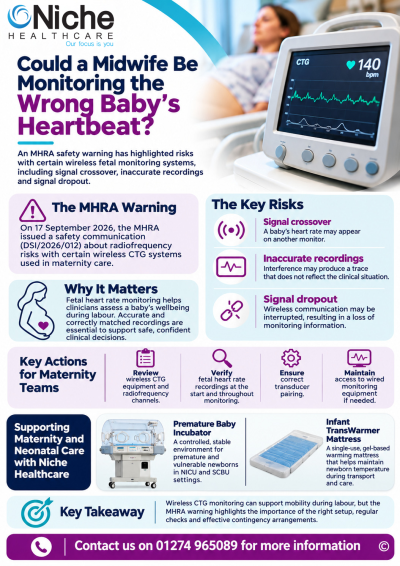
Wireless CTG Monitoring Risks Infographic
See our full selection:
Healthcare Supplies in Aberdeen | Niche Healthcare
Healthcare Supplies in Basildon | Niche Healthcare
Healthcare Supplies in Basingstoke | Niche Healthcare
Healthcare Supplies in London | Niche Healthcare
For procurement details, bulk purchasing, and further product information, contact our team today on 01274 965089 or check out our website at www.nicheofficesolutions.co.uk / www.nicheofficesolutions.co.uk/niche-nhs
Further clinical information can be found on our blog page: www.nicheofficesolutions.co.uk/category/niche-healthcare-news
For products not found on our online website, please view our Healthcare catalogues: www.nicheofficesolutions.co.uk/healthcare-catalogues
View our Healthcare YouTube videos Playlist
If you have any additional questions, drop us an email at info@nicheofficesolutions.co.uk